Why should you register a Trade Mark in the UK?

If you are reading this article, you may be considering registering a trade mark in the UK but still have some doubts. In this article, we aim to address your concerns and answer the key questions you may have before registering a trade mark.
First and foremost, a trade mark is a valuable business asset protected by intellectual property law, granting its owner exclusive proprietary rights.
Intellectual property rights include:
- The right to use the intellectual property.
- The exclusive right to authorise others to use the intellectual property.
- The exclusive right to prevent unauthorised use of the intellectual property, including the right to prohibit such use.
In practice, registering a trade mark in a particular jurisdiction provides its owner with a legal basis for using the mark in the country where it is registered, as well as the ability to take action against third parties who unlawfully use an identical or similar mark within that jurisdiction.
In this context, trade mark registration in the UK is particularly relevant given the size of its market and the country’s significant role in international business.
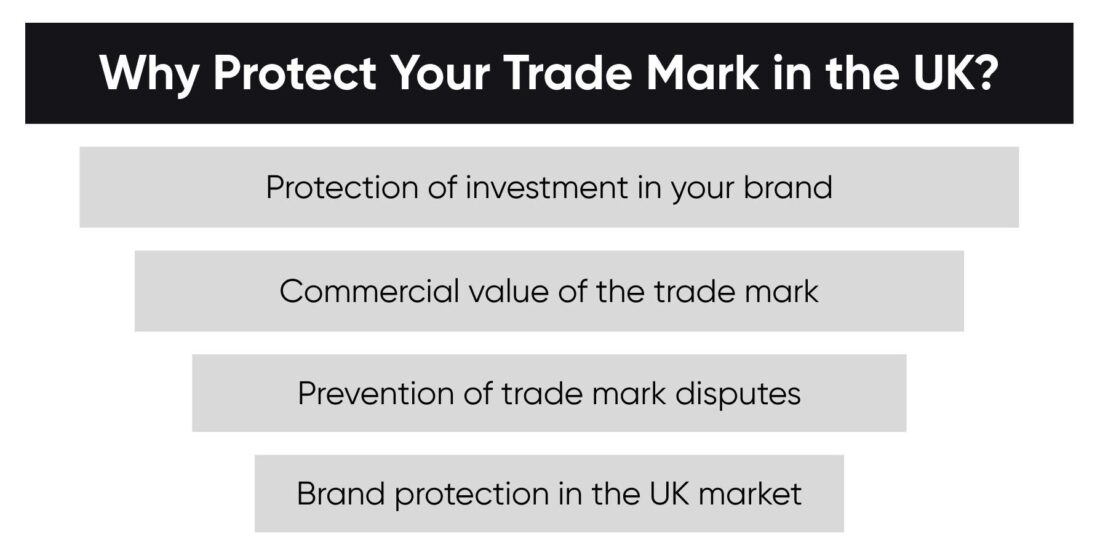
The need to register a trade mark in the UK arises, in particular, when planning to sell goods or provide services in the UK market, launch a local website or marketplace, enter into partnership agreements, or expand business operations in the UK.
Importantly, an EU trade mark registration does not, in itself, provide legal protection in the UK, as trade mark rights are territorial in nature.
Furthermore, the UK trade mark registration system generally gives priority to earlier applications, meaning that delaying registration may create a risk of another party registering your brand first. Even when entering the market through distributors or partners, a registered trade mark remains a valuable commercial asset and an important legal tool for protecting your brand.
What could happen without trade mark registration?
If a trade mark is not registered in the UK, its owner cannot rely on the statutory remedies available for registered trade marks.
Under Section 2(1) of the Trade Marks Act 1994, a registered trade mark is a property right acquired through registration under the Act, and its proprietor is entitled to the rights and remedies provided for by the Act.
However, Section 2(2) of the Act contains an important qualification: although infringement proceedings cannot be brought in respect of an unregistered trade mark as such, the Act does not affect the law relating to passing off. This means that unregistered brands may still benefit from legal protection under common law. Such protection is available through a passing off action, which generally involves preventing misrepresentations that mislead consumers about the commercial origin of goods or services.
Therefore, for businesses operating in the UK, the absence of trade mark registration creates ongoing legal risks. Without registration, enforcing trade mark rights in court can be considerably more difficult and costly, whereas a registered trade mark provides a clearer legal basis for protecting a brand against unauthorised use and acts of unfair competition.
Key features of trade mark registration in the UK
Examination of Trade Mark Applications
The UK Intellectual Property Office (UKIPO) examines trade mark applications to ensure compliance with legal requirements, particularly the absolute grounds for refusal set out in Section 3 of the Trade Marks Act 1994. These include a lack of distinctive character, descriptive marks, signs that have become customary in the trade, certain restrictions relating to the shape of goods, marks that may deceive consumers, marks contrary to public policy or accepted principles of morality, and applications made in bad faith.
The risk of likelihood of confusion between trade marks falls under the relative grounds for refusal set out in Section 5 of the Act. This includes, in particular, situations where the applied-for mark is identical or similar to an earlier trade mark and the goods or services are identical or similar, giving rise to a likelihood of confusion among consumers.
Under Section 38 of the Act, once a trade mark application has been accepted, the Registrar must arrange for its publication. Following publication, any person may file a written opposition to the registration within the prescribed period, stating the grounds for opposition. In addition, before the trade mark is registered, any person may submit written observations to the Registrar as to whether the mark should be registered.
Address Requirements
Under Rule 11(4) of the Trade Marks Rules 2008, applicants must provide a UK address for service to which the UK Intellectual Property Office (UKIPO) can send documents and official correspondence.
Such an address is required, in particular, for filing a trade mark application and participating in opposition, revocation or invalidation proceedings. Therefore, applicants who do not have a qualifying address for service must appoint a local representative to handle communications with the UKIPO.
Furthermore, if a logo has been created by external contractors or designers, a clear chain of title for the relevant intellectual property rights should be properly documented before filing the application to avoid potential challenges from the creators.
Intention to Use
When filing a trade mark application, the applicant must confirm that the trade mark is already in use or that they have a bona fide intention to use it in relation to the specified goods or services.
At the same time, Section 46(1)(a) of the Trade Marks Act 1994 provides for the revocation of a trade mark registration if the mark has not been put to genuine use in the UK within five years following the completion of the registration procedure, without proper reasons for non-use.
Therefore, the list of goods and services in the application should reflect the actual or genuinely intended use of the trade mark. This requirement aims to prevent the bad-faith practice of registering trade marks merely to reserve them without any genuine intention to use them in the course of trade.
If an application for revocation is filed, the trade mark proprietor bears the burden of providing sufficient evidence of genuine use of the mark in the course of trade. If such use cannot be demonstrated during the relevant five-year period, the registration may be revoked in whole or in part in respect of the relevant goods or services.
Trade Mark Protection in the UK After Brexit
The UK’s withdrawal from the European Union led to the separation of their trade mark protection systems. The UK and EU now have distinct systems for trade mark registration and legal protection. Previously, an EU trade mark registration also extended to the UK. However, following Brexit, new applications filed with the European Union Intellectual Property Office (EUIPO) no longer provide trade mark protection in the UK. Accordingly, companies operating in both markets must take into account the territorial scope of trade mark rights and ensure that their brands are protected in each relevant jurisdiction.
However, the separation of the UK trade mark system does not mean a complete departure from the legal principles established under EU law. Certain provisions of UK trade mark legislation continue to reflect principles derived from EU law, and relevant judgments of the Court of Justice of the European Union (CJEU) delivered before the end of the Brexit transition period may still be taken into account when interpreting those provisions. Therefore, although the UK’s current trade mark protection system operates independently, some of its legal principles remain rooted in EU law.
Practical cases
Case 1.
VOLTEN, INC. v Foltene Laboratories S.r.l. (O/0732/24)
| Applicant | VOLTEN, INC. |
| Opponent | Foltene Laboratories S.r.l. |
| Subject of the dispute | VOLTEN, INC. filed an application to register the composite trade mark “VOLTEN” in the UK for a range of goods and services in Classes 3, 8, 11, 26 and 35. |
The Italian company Foltene Laboratories S.r.l. opposed the registration of the applicant’s trade mark in respect of goods in Class 3. Foltene Laboratories S.r.l. argued that the marks “FOLTENE” and “VOLTEN” were highly similar and that the goods covered by the application were identical or highly similar to those protected by its earlier trade mark registrations. According to the opponent, the combination of similarities between the marks and the goods gave rise to a likelihood of confusion among consumers, including the likelihood of association between the marks.
VOLTEN, INC. contested the opposition and disputed the grounds put forward by the opponent. The applicant argued that the marks “FOLTENE” and “VOLTEN” were sufficiently different visually and phonetically and therefore did not give rise to a likelihood of confusion.
Following its examination of the case, the UKIPO found that there was a likelihood of confusion among consumers and upheld the opposition filed by Foltene Laboratories S.r.l. As a result, the application to register “VOLTEN” was refused in respect of goods in Class 3.
This case demonstrates that having a registered trade mark in the UK enables its proprietor to effectively prevent the registration of similar marks and protect the market against the risk of consumer confusion. Early trade mark registration provides proprietors with a practical legal mechanism to oppose potentially conflicting marks during the UKIPO registration process.
Case 2.
Soni Air Limited v Sony Group Corporation (O/0194/24)
| Applicant | Soni Air Limited |
| Opponent | Sony Group Corporation |
| Subject of the dispute | Soni Air Limited filed an application to register the composite trade mark “SONI AIR” in Classes 35 and 36. Sony Group Corporation opposed the registration, relying on its earlier registered trade mark “SONY” and Sections 5(2)(b) and 5(3) of the Trade Marks Act 1994. The opponent argued that the marks were similar and that the services covered by the application were identical or similar, giving rise to a likelihood of confusion among consumers. |
The UKIPO noted that “SONY” and “SONI” could be mistaken for the same mark, as they would be pronounced identically by a significant proportion of consumers. The word “AIR” and the figurative element of the “SONI AIR” mark could be perceived as indicating that Sony’s services were provided via the Internet. As a result, consumers might perceive “SONI AIR” as a sub-brand of Sony. The UKIPO therefore found a likelihood of indirect confusion.
Ultimately, the opposition was successful, and the trade mark application was refused.
This case demonstrates that changing individual elements of a mark or adding descriptive words does not necessarily eliminate the likelihood of confusion if its dominant element remains similar to an earlier registered trade mark. Therefore, before filing an application, it is important to conduct a trade mark clearance search covering not only identical marks but also similar marks in relation to the relevant goods and services.
Conclusion
Registering a trade mark in the UK is more than just a formality. It is an important part of a business strategy for entering the UK market and protecting your business interests. Early registration helps secure legal protection for your brand in the relevant jurisdiction and reduce the risk of disputes with owners of identical or similar marks.
Before entering the market, it is advisable to conduct a trade mark clearance search to identify identical or similar marks, ensure that the selected classes of goods and services reflect your business activities, and assess potential conflicts and risks associated with using your brand.
Our team can conduct a comprehensive trade mark search and analysis, assess potential risks, and help you develop a brand protection strategy before entering the UK market. We look forward to working with you.